A pool cage is an engineered aluminum wing. To survive 150MPH winds, three things must hold: the Tapcon anchors in the concrete, the K-Bracing cables in the corners, and the structural screws in the joints. If any one of these fails due to rust, the entire structure can collapse. Furthermore, insurance adjusters often deny claims for collapsed cages if they find evidence of "prior maintenance neglect" (rust). Restoration is not just about painting; it's about re-engineering the cage to its original wind load rating.
Living in Tampa Bay means accepting a harsh reality: June 1st is always coming. While most homeowners focus on plywood for their windows and gas for their generators, they often ignore the largest, most expensive structure on their property—the pool cage.
A standard 20x40 pool enclosure represents $30,000 to $45,000 of asset value. Yet, every hurricane season, we see dozens of cages crumpled like aluminum foil. Why? It rarely has to do with the strength of the aluminum beams themselves. Aluminum is an incredibly resilient material that does not rot or degrade like wood.
The failure points are almost always the connectors. At Suncoast Restoration, we treat every restoration project as a structural reinforcement job first, and a painting job second.
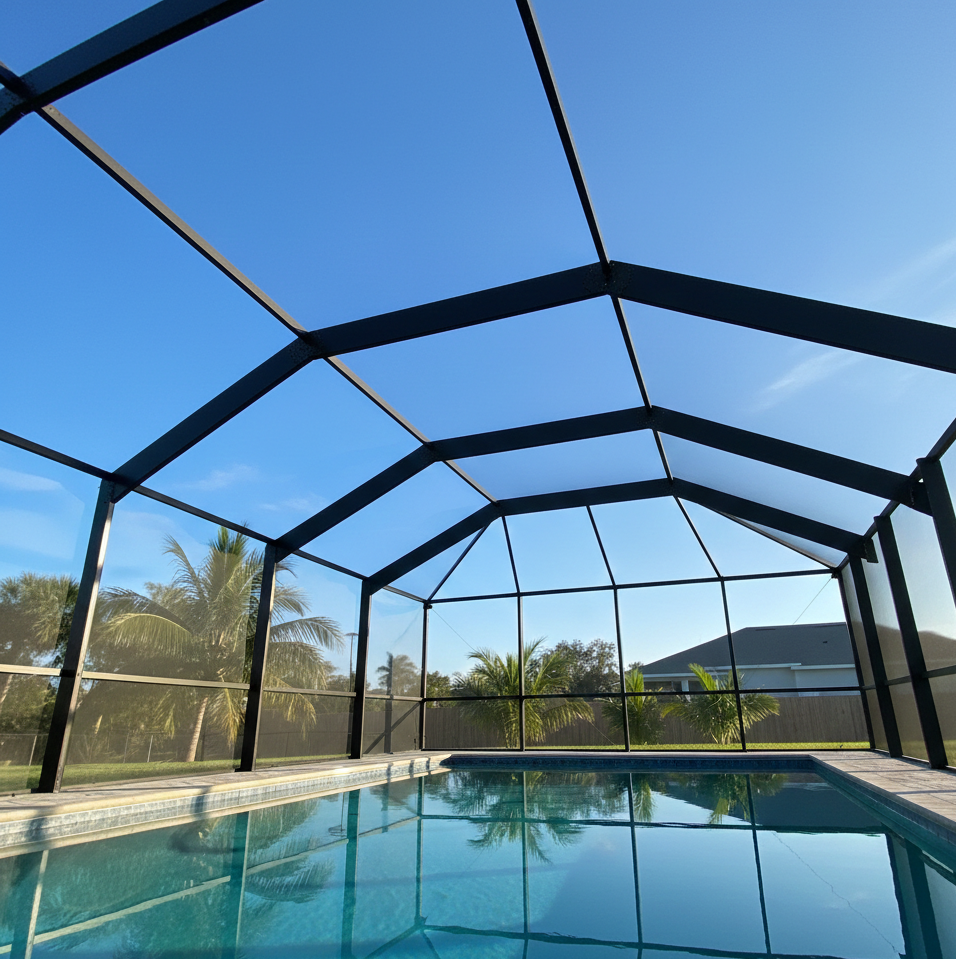
The Physics of Failure: Uplift vs. Shear
To understand why cages fail, you have to understand what a hurricane actually does to the structure. It isn't just "pushing" on the screen.
1. Uplift (The Parachute Effect)
When wind moves rapidly over the curved or mansard roof of your cage, it creates an area of low pressure above the screen (Bernoulli's principle). This creates massive "uplift" forces. Essentially, the storm is trying to suck your cage straight up out of the concrete deck.
This is why your Concrete Anchors are the most critical component. If they are rusted, the cage simply rips out of the ground.
2. Shear (The Twist)
Hurricanes are not straight-line winds; they are turbulent. The wind pushes against the side walls, trying to "rack" the cage (push it over sideways). The aluminum vertical beams have very little lateral strength on their own. They rely entirely on the tension of the K-Bracing Cables to keep the structure square.
The Silent Killer: Rusted Concrete Anchors
Your pool cage is bolted to your concrete deck using anchors commonly called Tapcons. These are usually blue, carbon steel screws driven directly into the slab by the original builder.
The Hidden Decay: Water pools on your deck. Over 10 years, that standing water (mixed with salt and chlorine) seeps into the microscopic gap between the screw and the concrete. The screw rusts inside the concrete, where you can't see it.
When a Category 3 storm hits, and that "uplift" force engages, these compromised screws snap instantly. We mitigate this by replacing accessible anchors with Pro-Tect® Stainless Steel systems. Unlike carbon steel, 410 Stainless is designed to live in concrete without corroding.
The "K-Brace" Cables: Your Cage's Muscles
Look at the upper corners of your pool cage. You should see steel cables stretching diagonally from the roof to the uprights. These are called K-Braces (or wind bracing). They act as the "muscles" of the cage, providing tension that prevents the aluminum frame from racking.
The Inspection Test: Go outside right now and grab one of these cables. Shake it.
- Good: It should feel tight, like a guitar string.
- Bad: It is slack, wobbly, or disconnected.
If the cable is loose, your cage has zero shear strength. In a hurricane, the wind will push the roof sideways. Without the tension of the cable to pull it back, the aluminum beams will reach their yield point and snap at the base. During our restoration process, we replace rusted cables with stainless steel aircraft cable and tension them to precise engineering specs.
The Insurance Trap: "Sudden" vs. "Long-Term"
This is the part most contractors won't tell you, but it is critical for your financial protection. Homeowners insurance covers "Sudden and Accidental" damage. It generally excludes "Long-term Maintenance Neglect."
Scenario A: A tree falls on your perfectly maintained cage. Insurance pays for a new cage.
Scenario B: A tropical storm blows your cage down. The adjuster arrives and inspects the wreckage. He finds that the screws at the joints were rusted through and the anchor bolts were corroded. He denies the claim, citing "Failure to Maintain."
By restoring your cage now—replacing the rusted fasteners with Nylo-Tec® and documenting the work—you are not just making it safer; you are bulletproofing your insurance claim eligibility. You have proof that the structure was maintained to code.
The "Super Gutter" Connection
For many homes in St. Pete and Sarasota, the pool cage attaches directly to the fascia of the house via a heavy-duty aluminum channel called a "Super Gutter."
This is the most critical joint in the entire system. It handles the water from your roof AND the structural weight of the cage. If the screws connecting the cage to the gutter are rusted (galvanic corrosion), the heavy cage can separate from the house during a storm.
If this happens, the cage often collapses into the pool, but sometimes it collapses backwards into the house, shattering sliding glass doors and causing massive interior water damage. During a restoration, we inspect every inch of this connection and re-secure it with heavy-gauge stainless hardware.
The Myth: "Should I Cut My Screens?"
This is the most common question we get every year: "The storm is coming. Should I run out and slash my screens to reduce wind drag?"
The logic seems sound: if you cut the screens, the wind blows through, reducing the pressure on the frame. However, engineering studies have shown this is a double-edged sword.
The Structure Argument: The screen mesh actually provides "diaphragm strength" to the structure. It acts like a skin that holds the beams in tension relative to one another. Cutting the screens removes this tension, potentially making the frame more wobbly.
The Reality: If your cage is properly engineered and maintained, it is rated to withstand the wind load with the screens intact (up to 140-150 MPH for modern codes). If your cage is rusted, cutting the screens won't save it.
Our Official Stance: We focus on building a structure strong enough that you don't have to make that panic decision. Spend your time boarding up windows, not slashing screens.
The Restoration Advantage: Resetting the Clock
Many homeowners think their 15-year-old cage is "too old" to save. They assume they need to spend $30,000 on a replacement. But as we mentioned, aluminum doesn't rot.
The beams are likely just as strong today as they were in 2010. The weakness is entirely in the hardware. By stripping the cage down, replacing every screw with Nylo-Tec, replacing the cables, and applying a structural electrostatic coating, we are effectively resetting the clock on the engineering of the structure.
You get a cage that is structurally equivalent to a new build, for 50% of the cost, without the hassle of permitting and demolition.
The 2026 Structural Checklist
Before the season starts, walk around your cage and look for these four things:
- Check 1: Inspect all lower anchor bolts for rust rings on the concrete.
- Check 2: Shake all K-Brace cables to ensure high tension.
- Check 3: Look for "Rust Bleed" (orange tears) on vertical uprights. This signals internal screw failure.
- Check 4: Check the "Super Gutter" (where the cage meets the house). Are the screws rusted? Is the paint bubbling?
If you fail any of these checks, your cage is compromised. It might survive a Category 1, but it is gambling with a Category 3.