Those orange streaks on your white pool cage aren't just ugly; they are evidence of structural failure caused by Galvanic Corrosion. Standard steel screws react with aluminum in the salty Florida air, causing them to snap. The only permanent solution is replacing them with Nylo-Tec® (nylon-capped) or marine-grade stainless steel fasteners to restore your cage's wind-load rating.
If you live in Tampa Bay, you have seen it. You look out at your beautiful pool area, and your eyes are immediately drawn to ugly, weeping orange streaks running down the white aluminum beams of your enclosure.
Most homeowners assume this is just an aesthetic issue—a cosmetic annoyance that needs a good pressure wash. They are wrong.
Those rust streaks are the visible symptom of a much deeper structural problem that compromises the safety of your entire enclosure, especially during hurricane season. At Suncoast Restoration, we estimate that 80% of cages over 10 years old in our area are relying on compromised fasteners.
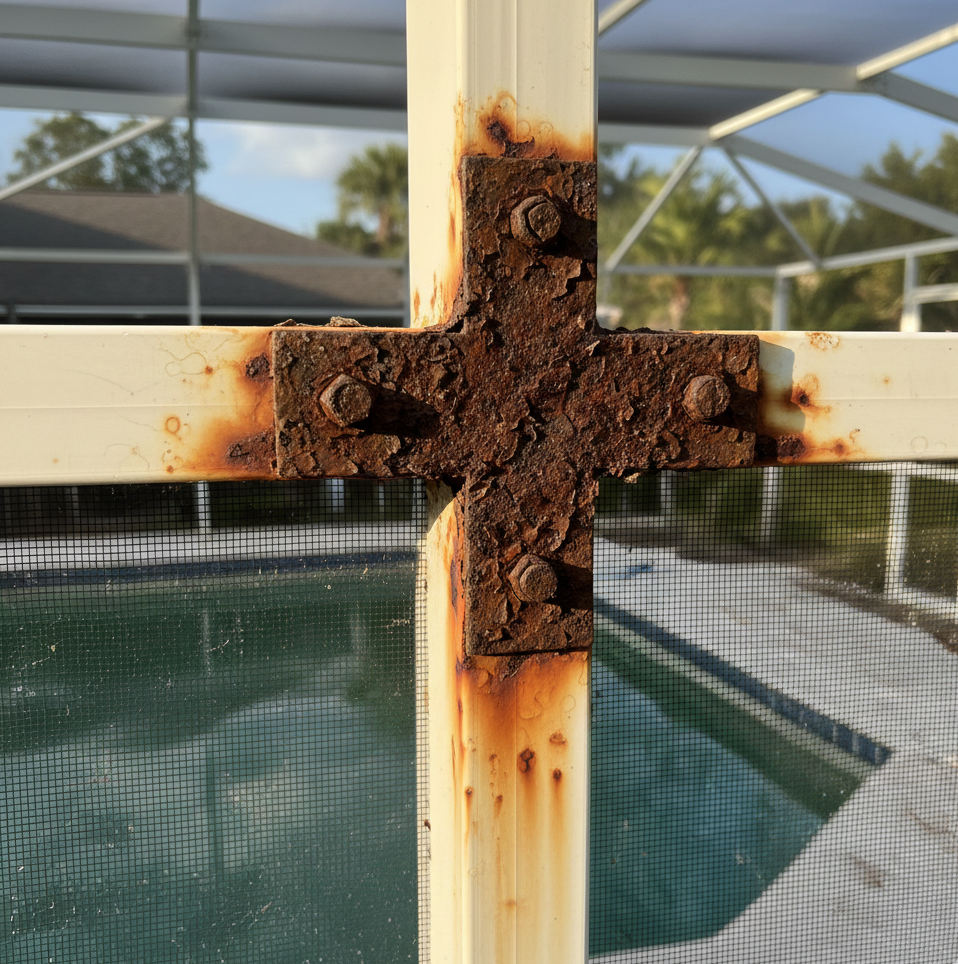
Typical "rust bleed" caused by builder-grade steel screws reacting with aluminum beams.
The Science: What is Galvanic Corrosion?
To understand why your screws are rusting, we need a quick chemistry lesson. Your pool cage is built from aluminum. The screws the original builder used to hold it together are almost certainly carbon steel (often lightly zinc-plated).
Aluminum and steel are "dissimilar metals." When you place two dissimilar metals in contact with each other and add an electrolyte—in our case, salty, humid Florida air or chlorine mist from the pool—you create a battery.
This process is called Galvanic Corrosion. The more "noble" metal (steel) eats away at the less noble metal (the zinc coating), and eventually, the steel itself begins to rapidly oxidize. The screw doesn't just get surface rust; it actually loses mass and strength, eventually snapping off inside the beam.
The Danger Hidden in Plain Sight
When a screw snaps due to corrosion, it is no longer holding the aluminum members together. The only thing keeping the beams connected is friction and the remaining screen tension.
The Wind Load Problem
Pool cages in Florida are engineered to withstand specific wind loads (often 140mph+ depending on when it was built). This engineering relies on every single fastener doing its job. If 30% of your screws have rusted through, your cage is no longer rated for a hurricane.
We frequently find cages where entire horizontal beams (chair rails) can be pulled apart by hand because the fasteners at the joints have completely disintegrated. For more on structural integrity, visit our Structural Restoration page.
The Solution Wars: Stainless vs. Nylo-Tec®
When restoring a cage, you cannot just put new steel screws back in. You must upgrade the metallurgy to stop the chemical reaction. There are two primary solutions used in the industry today.
Option 1: Marine Grade Stainless Steel (304/316)
Stainless steel is significantly more resistant to rust than carbon steel. For inland areas (like Brandon or Lutz), 304 stainless is often sufficient. For coastal areas (like St. Pete Beach or Clearwater), 316 marine grade is required.
- Pros: Strong, widely available, proven track record.
- Cons: They are still a dissimilar metal to aluminum. While they won't rust *themselves*, they can sometimes cause the *aluminum* around them to corrode eventually. They also don't match the cage color (silver heads on a bronze or white cage).
Option 2: The "Forever" Solution – Nylo-Tec®
This is the industrial standard for coastal Florida. A Nylo-Tec fastener is a high-grade steel screw that features a thermal-molded, UV-resistant nylon cap over the head.
This nylon cap serves two vital functions:
- It hermetically seals the head of the screw from salt air and water, making rust impossible.
- It is factory-colored to match your cage (White or Bronze), eliminating the need for touch-up paint that eventually flakes off.
According to industry best practices regarding aluminum structures, isolating dissimilar metals is the key to longevity in marine environments.
The Suncoast Restoration Process
A "Re-screw" is a surgical process. We don't just take all the screws out at once, or the cage would collapse. Our technicians methodically move around the structure, removing one rusted screw at a time and immediately replacing it with a larger diameter, industrial-grade fastener to ensure a tight new bite into the aluminum.
Don't wait until a tropical storm reveals the weakness in your structure. Those orange streaks are a warning sign that needs attention today.